
BWF Zuri recently completed an international fundraising program assessment and benchmarking project with several US-based research institutions, resulting in valuable insights into international fundraising. This article dives into the second area of consideration that is key for an effective international fundraising program.
Success Factor #2: Appropriate Funding
As you’ll recall from the previous posts in this series, BWF Zuri completed an international fundraising program assessment and benchmarking study with several US-based institutions that maintain a fundraising presence outside of the United States. The first factor we discussed as critical to successfully raising money abroad was structural consistency. The second factor, and the topic we’ll discuss in this post, is appropriate funding.
Appropriate funding seems pretty straightforward at first glance. However, when it comes to international travel, budgeting is anything but simple. How your organization determines when to travel to a location, how often, and who should make the trip is complicated enough—you also need to determine which budget covers these costs. Appropriately funding an international fundraising program often requires strategic guidance and input from several areas across your institution, including programs, finance, and senior leadership.
Ranking/Prioritizing Philanthropic Travel
The first step in appropriately financing an international fundraising program is prioritizing the markets in which you plan to maintain a presence. Many organizations grow international fundraising organically, responding to constituents as they interact and deepen their relationships. This often means that there are a handful of deeply engaged donors located across the globe, with perhaps a handful of locations with more active donor, volunteer, alumni, and friend populations. These locations may be based off a physical location (e.g., a satellite campus, treatment center, or study abroad partner) affiliated with your organization.
It’s important to review not just where you already have a donor presence, but also to review the potential of a market to support an active fundraising presence based on overall potential via a modified capacity analysis. Conducting a capacity analysis of a donor base is a well-known practice in modern fundraising programs. Simplistically, it’s a way to combine both inclination of your donor base with the overall potential of certain constituents to give at varying levels. You don’t just want to know who supports your organization already within a certain area; you want to know what the overall “share of wallet” is that you’re receiving from these constituents. If someone is currently giving $5,000 a year but has the ability to give $500,000 a year, that donor can be cultivated further to determine if they have an interest in supporting you at a higher level.
Beyond a capacity analysis, you need to add one more layer for international constituents—the relative ease or difficulty of making a gift to a US-based institution from within that country. Once you know that, you can layer that third set of information into the other two to create what we’ll call a Global Constituency Analysis. This allows you to attach “scores” to each international region with a ranking (unique to your organization and constituency) that shows how worthwhile it would be to invest in fundraising within a region based on donor engagement, capacity, and ease of international donation. We will get further into the details of this analysis in the next article in our series, so stay tuned!
Coordinating Travel Activities
Once you know which countries you are prioritizing for either in-country staffing or recurring institutional travel, the next step is to develop a travel budget and coordinate activities for everyone within the organization who might travel to the prioritized areas.
Travel budgets can be built in many different ways, but the most common approach is to develop a plan within advancement for the number of trips to an area in a year and the amount of people who will staff this trip. The centralized team or team member who puts this together should also meet with other organization representatives (e.g., enrollment professional, provost, head of the research program, chief scientist, or touring academic/artist) to learn about their planned travel for the year. This could include just one area of the organization or several core areas. If other representatives already have travel funding built into their budgets, check to see if the fundraiser affiliated with their area could staff the trip within their program budget or if advancement would need to cover their costs. Once all planned trips have been accounted for, review where there are gaps in the schedule, what anticipated budget remains, and fill in any gaps with the fundraising and engagement team. In time, you can start to project out for these trips so you can build a program budget over several years. (See the next section for a practical example of this budget build-out.)
Another key consideration for coordinating travel activities is having a timeline/shared travel calendar so the centralized fundraising team knows where and when international travel is happening and can support these trips with on-site or remote outreach and follow-up. Organizations using a Google calendar environment can easily create a shared calendar where travel is added to by multiple parties and monitored or maintained by a central fundraising resource. Organizations using an Outlook calendar environment can create a group calendar that is accessed by everyone who travels internationally. When a trip is planned and added to a user’s personal calendar, that user can invite the group so the trip is added onto the international calendar. If the personal invite is updated, the updates will be reflected on the group calendar as long as they are still invited to the event.
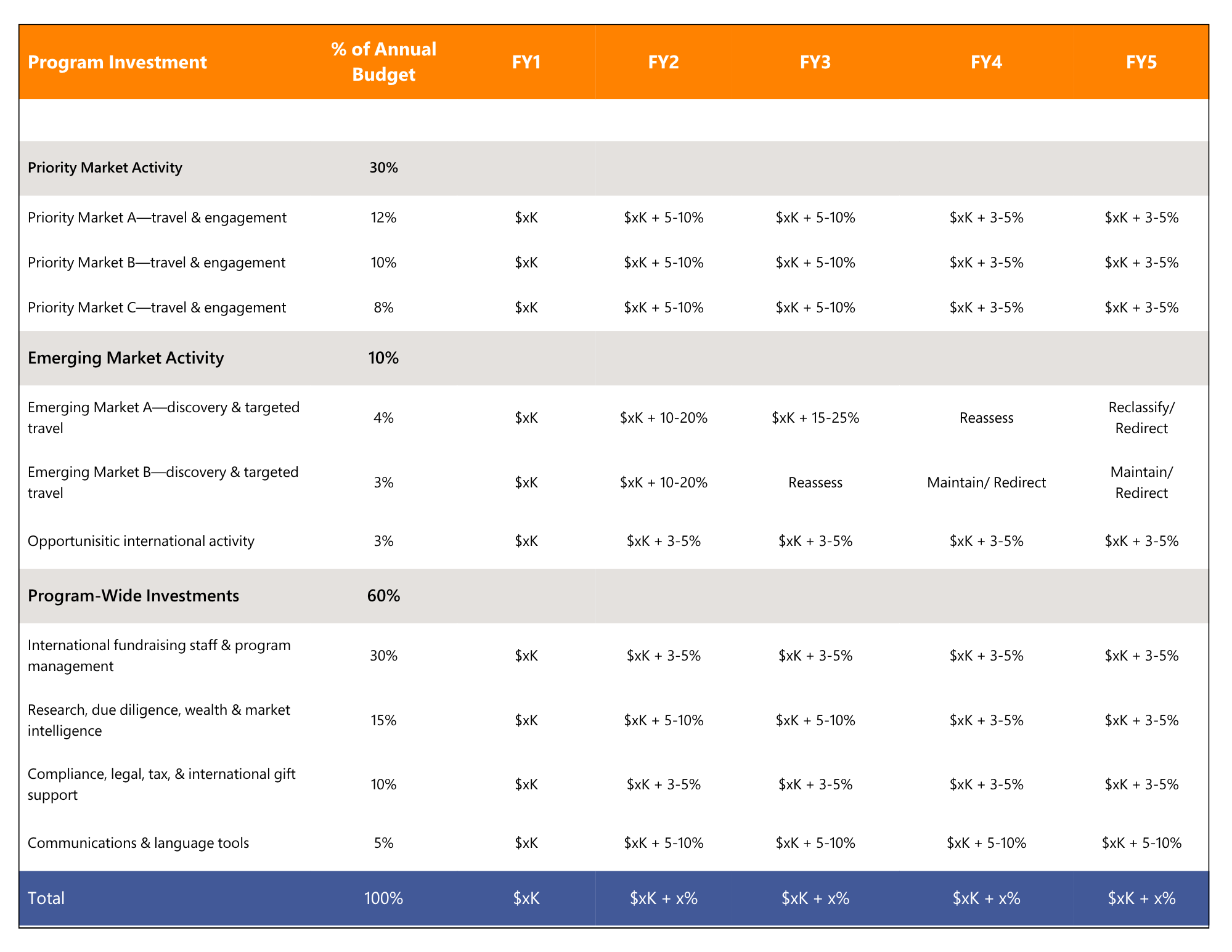
Practical Example: Create a Multi-year International Program Budget
A five-year international program budget should align with organizational strategy and priorities while allowing investments to grow incrementally and be reassessed based on market potential, constituent engagement, and demonstrated fundraising opportunity. Annual increases should be calculated using the prior year’s budget to account for compounded growth, while investments in emerging markets should be reassessed regularly as opportunities develop.
As you’ll notice in the example below, emerging markets are evaluated in years 3 to 5 for potential inclusion as a new priority market or for exclusion as a market area if a presence in the market has not yielded the anticipated results. This is especially important as new programs are introduced that may attract constituents from new international locations.
Conclusion
Budgeting and planning are important in every level of philanthropic investment, but they can be more difficult to predict in the context of international fundraising. The first step to maximizing your investment in international fundraising is to know which markets provide the greatest potential for your organization. The second is to coordinate with areas of your organization outside of philanthropy to know the full impact and presence your organization has in each international market. Finally, you can take all of the information you’ve learned and build a five-year budget that will allow longer-term strategic planning.
If you would benefit from a deeper dive into any of these topics, contact us. Stay tuned for the next topic in the series—the type of research required as you consider international funding locations. This is an ongoing series; sign up below to receive the full results and the rest of this series in your inbox!