
Across the country, colleges and universities are seeing record-setting fundraising years. According to the CASE Insights report, gifts to American colleges and universities rose to an estimated $78.8 billion in the fiscal year of 2025, a 4% year-over-year increase. These institutions are seeing increasingly high gains in all types of fundraising campaigns, from crowdfunding to donor-advised funds (DAFs).
Your university may have the potential to achieve greater financial success, but lack the fundraising resources and strategies needed to kickstart your plans. In this guide, the higher education fundraising experts at BWF Zuri review effective strategies and trends universities should be aware of to build a strong, sustainable fundraising approach:
- What Higher Ed Fundraising Trends Should You Be Aware of in 2026?
- University Fundraising Best Practices to Help Raise More
- University Fundraising: FAQs
Your university’s community is made up of passionate students, faculty, alumni, and parents, many of whom are more than willing to support your organization through giving. With these fundraising strategies, you can streamline the giving process and connect with more potential donors.

What Higher Ed Fundraising Trends Should You Be Aware of in 2026?
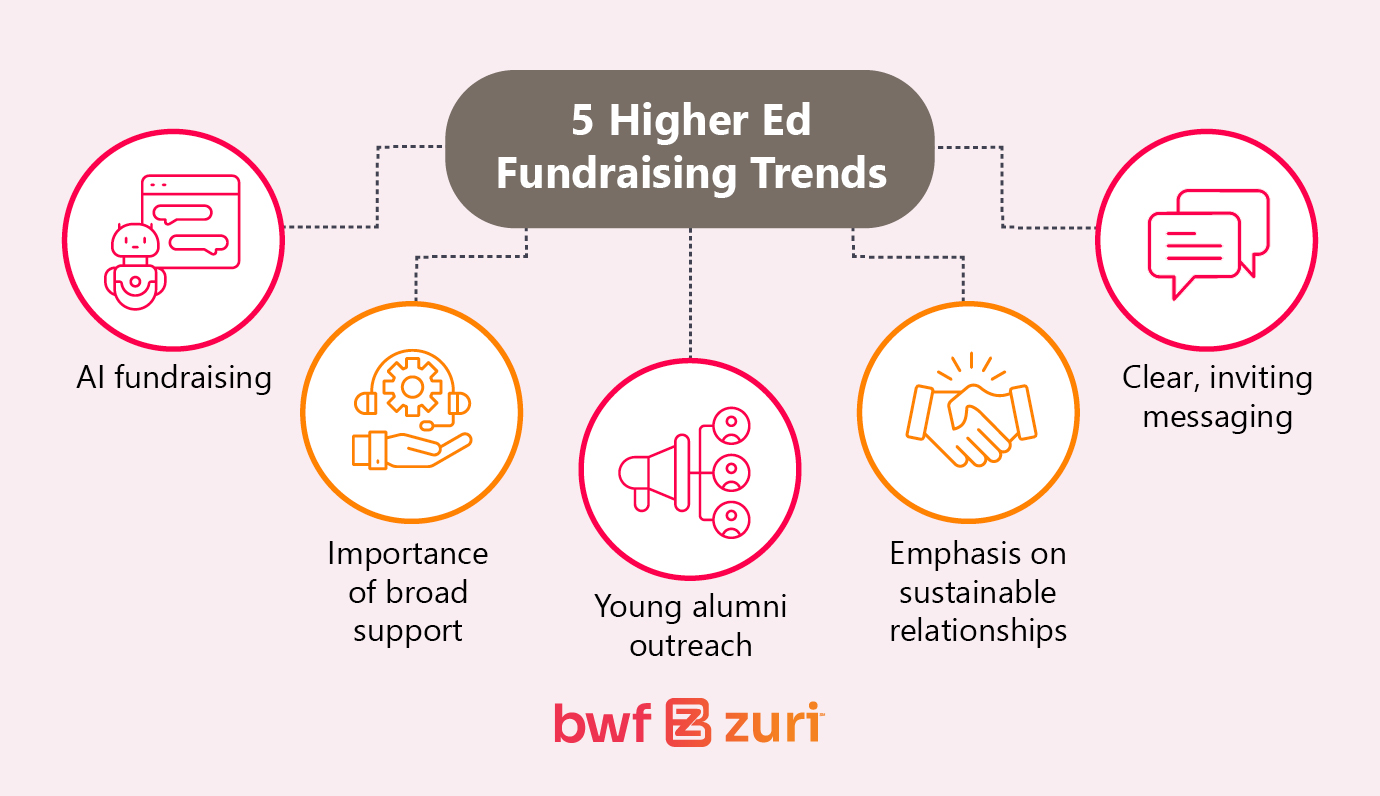
The top university fundraising trends for 2026 include the rapid adoption of AI fundraising tools, a shift toward cultivating non-alumni support, engaging young alumni through networking, prioritizing sustainable relationships, and using experiential donor recognition. Let’s explore these five trends in more detail.
1. AI fundraising
Fundraising using artificial intelligence (AI) tools has recently become more accessible to higher education institutions. Universities are using these tools for the following tasks:
- Content generation. AI tools can help brainstorm new ideas for content creation, such as email subject lines, social media posts, blog posts, and fundraising scripts. AI solutions can also personalize your marketing outreach by automatically entering donors’ names, past donation amounts, details of past interactions, and other relevant information into your communications.
- Prospect research. AI fundraising solutions, such as predictive models, can help you identify potential new donors, donors likely to renew or increase their giving, and supporters likely to become principal, major, or planned givers.
- Next action recommendations. AI solutions can offer next-action recommendations, such as the appropriate donation amount to request from a specific donor or the best time to ask for a gift based on your stewardship cadence. Using AI for this purpose can help improve your donation conversion rate and maintain positive donor relationships.
- Task management. AI tools can streamline and automate manual or repetitive tasks, such as data entry and hygiene, project management, email outreach, and donation processing. As a result, nonprofit professionals have more time in their days to focus on the mission-driven activities that matter most, such as in-person donor stewardship.
If you’re interested in expanding your AI fundraising efforts, it can be helpful to reach out to a data analytics expert who can recommend the right solutions and strategies that will work best for your fundraising goals. These professionals can ensure your CRM is clean and ready to support your AI fundraising initiatives with accurate, updated data.
2. Importance of broad support
According to the latest CASE Insights on Voluntary Support of Education report, while total giving to higher education has increased, the overall number of alumni donors is actually shrinking. As a result, institutions are increasingly relying on a narrower, higher-capacity donor base to sustain their philanthropic revenues.
What does this mean for university fundraising? As everyday alumni participation declines, development teams can no longer afford to rely on a single demographic to meet their annual goals. To protect against this shrinking donor pool, fundraising professionals must aggressively expand their outreach and cultivation tactics.
To maintain a broad base of support and reliable fundraising streams, fundraising professionals shouldn’t just focus on cultivating alumni relationships, but also relationships with:
- Current students
- Parents and families
- Faculty and staff
- Corporate partners
- Foundations
Use our interactive spinner to determine the best ways to engage with each of these donor groups:
Encouraging participation across these diverse groups will help offset the drop in everyday alumni participation and build a more resilient giving pipeline.
3. Young alumni outreach
Engaging young alumni is essential to building a sustainable future for your higher ed fundraising program. However, fundraising studies have shown that young alumni giving rates have decreased by 18% over the past decade. Many interviewed alumni cited a lack of meaningful engagement or value.
The truth is that young alumni need support in their first few years out of college. That support may come in the form of personal relationships and social support, as well as professional development support. Your university can fulfill both of those needs.
For example, your alumni chapters can host social events like watch parties for sporting events or homecoming parties. In addition, you can schedule professional development opportunities, such as networking events or leadership workshops.
Show young alumni that your university is still there to support them as they take their first steps into the working world. In return, they’ll be more likely to show their gratitude and support their alma mater with donations.
4. Emphasis on sustainable relationships
Your relationships with higher education donors shouldn’t be purely transactional. It’s important to build a real relationship with prospective donors before asking for gifts.
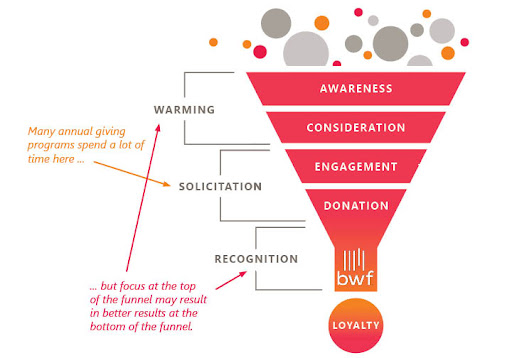
Foster relationships by taking these steps:
- Show donors that you’re genuinely interested in them as individuals. Send surveys to ask alumni what they’re doing post-graduation and how your university can continue to support them.
- Communicate with supporters about more than just fundraising. Your university has a lot going on beyond your fundraising efforts. Let audience members know about upcoming events, volunteer opportunities, and other activities they may be interested in.
- Show authentic appreciation and let donors know the impact of their gifts. For example, you can let donors know their gifts will support scholarships or renovations to your main library. We’ll explore more tips for demonstrating impact later on in this post.
Donors will be much more willing to show their support when your university has made a deliberate effort to build genuine relationships with them.
5. Clear, inviting messaging
One simple fact has always remained true about university donors: they don’t just give to support your school. They also want to feel a part of something larger than themselves.
Show donors that they’re not just making a gift that will positively impact your university—they have the opportunity to join a community of fellow donors and be part of a special group.
Create donor testimonials and profiles for your email newsletter or blog that introduce audience members to your most engaged or active donors. Also, consider naming your donor group and creating different tiers based on giving level, each with its own perks. For example, lower-tier donors may be able to access early event sign-ups while higher-tier supporters can receive invites to exclusive events with your university’s president.
90% of donors prefer experiential recognition over physical formats like letters or gifts. Therefore, you should plan special appreciation events and opportunities for donors, such as networking nights, sports watch parties, or reunions. Make sure to host events in multiple cities to include alumni who moved out of your local area after graduation.
University Fundraising Best Practices to Help Raise More
How does a university level up its fundraising into the million or even billion-dollar range? It starts with a clear strategy, team collaboration, and data-driven insights. Follow these best practices to take your campaigns to new heights:
1. Use your software solutions effectively.
When it comes to effective university fundraising, internal readiness is critical. Evaluate your institution’s fundraising capacity and resources to ensure your systems are well-positioned to conduct research and prospecting.
As you assess the readiness of your systems and operations, work with your team or an external fundraising consultant to evaluate the resources and tools currently available to you. These may include your CRM, analytics tools, and marketing platform. Optimize these systems to ensure they’re serving your organization effectively and that you’re making the most of them.
For example, do you have significant gaps in your audience profiles within your CRM, such as missing email addresses or phone numbers? If so, you might look into conducting a data append to supplement your records with additional information.
Or, does your higher ed fundraising team lack strong data hygiene policies to keep your internal records organized? In this case, spend some time developing guidelines for your fundraising team to follow regarding data collection and entry.
If you need to invest in new fundraising software solutions to expand your capacity, you may have to make a case for these investments to other leaders at your institution. Focus your persuasion tactics on the potential return on investment from implementing high-powered fundraising systems.
2. Understand your donor pool.
Learning more about your university’s potential donors will help you create targeted outreach campaigns that appeal to their unique interests and motivations.
The first step of the donor research process is to conduct prospect research. Prospect research is the process of identifying donors who are most likely to give to your university based on their giving capacity and personal connection to your university.
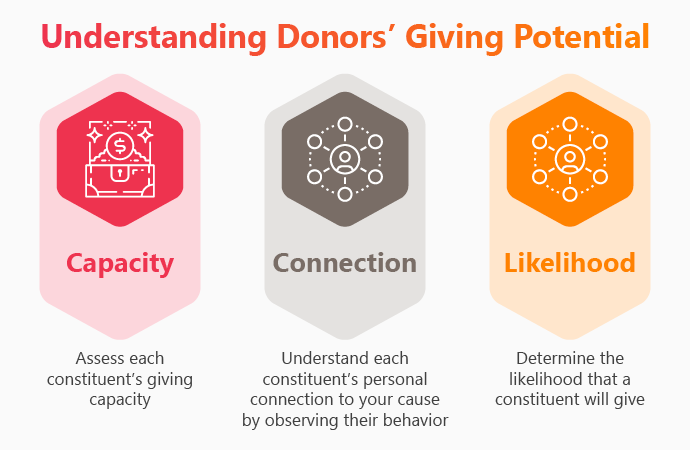
As part of this process, you can work with a fundraising consultant or your fundraising team to research potential donors’ giving capacity and propensity.
Identify donors who exhibit:
- Wealth indicators such as stock ownership, real estate holdings, and business affiliations. These indicators will help you understand a prospective donor’s capacity to contribute a larger gift. Wealth screenings help prioritize information within large datasets. However, capacity verification on high-potential prospects, especially those largely unknown to your organization, is a vital next step. This is where a fundraising consultant can make a significant difference in verifying and creating a list of priority prospects.
- Affinity indicators, including involvement with student groups or alumni associations, political donations, past volunteering, and other areas of interest related to your institution. These characteristics will indicate that a prospective donor has a strong affinity for your university.
In addition to identifying audience members who exhibit these characteristics, you can use supplementary research strategies, such as data modeling and artificial intelligence, to automate and streamline the donor research process.
For example, predictive modeling techniques anticipate donors’ future behaviors based on past information you’ve gathered about them. In addition, AI fundraising tools can process large volumes of data and uncover audience insights, saving your team time and effort.
If you’re interested in using these advanced techniques, we recommend working with a fundraising consultant who can help build your team’s internal capacity and leverage powerful tools and resources. For example, BWF Zuri offers outsourced prospect management and research as well as engagement scoring, which helps universities predict core engagement metrics like pride, passion, and awareness.
3. Define your audience personas.
It would require a lot of work and time to create personalized communications for every individual in your fundraising database.
That’s why it’s helpful to expand your focus and group audience members into segments based on shared characteristics. After identifying your audience’s most commonly shared characteristics, you can develop personas based on each archetype you discover.
You can use two approaches to define your audience personas:
- Supervised model building or persona scoring involves defining the factors you think will be most important for grouping your audience members. You can make these determinations based on the groups you think will be most valuable or what makes each group distinctive. For instance, your institution might prioritize building relationships with alumni over developing connections with students’ family members.
- Unsupervised model building or clustering allows the data to sort itself out, meaning your audience members will group themselves based on demographics, engagement, giving levels, and other activities they’re involved in. This approach uses an algorithm and doesn’t require intervention from your marketing team on how to group supporters.
No matter what strategy you use, the end result should be clearly defined audience groups that give you a better understanding of your audience’s shared characteristics. You might end up with alumni groups based on age or class year, geographic location, interests, and other indicators that help you determine what your audience is more interested in.
Once you’re aware of these groups, you can create tailored marketing campaigns that connect with each segment on a more personal level by referencing their unique interests and motivations.
4. Create a multichannel marketing strategy.
As you conduct ongoing audience research, you’ll probably discover that different personas have different preferred communication channels. For example, students’ parents might prefer channels like email, while young alumni prefer communication via social media.
No matter what type of campaign you’re managing—whether a giving day campaign, holiday initiative, or homecoming campaign—using a multichannel digital marketing approach will help you reach the broadest possible audience.
Keep the following channels in mind for conducting outreach:
- Email. According to the 2026 M+R Benchmarks report, email revenue increased by 16% in 2025, and the share of all online revenue directly sourced to email was 11%. That means email is a great way to reach your audience daily. Ensure your email messages are short and that they include compelling subject lines to increase engagement.
- Social media. All of your university’s core demographics are likely present on social media, including current students, alumni, faculty, staff, and parents. The keys to successful fundraising on social media are consistency and authenticity. Standardize your brand elements, such as your fonts, colors, and tone, across all social media platforms to promote cohesion. Also, ensure your social media platforms feature plenty of photos and videos of the students who benefit from donors’ gifts.
- Direct mail. A direct mail fundraising campaign allows you to provide an engagement opportunity outside the crowded digital realm. You can send notifications for upcoming events, volunteer opportunities, and fundraising opportunities for alumni or families to get involved in. You can also send fun, surprise extras like bumper stickers or photos of your school’s campus.
- Video. Create engaging, short-form video content showcasing student testimonials, fundraising updates, and donor appreciation messages. Share the videos across digital platforms, including email, social media, and your website, to reach a wider audience.
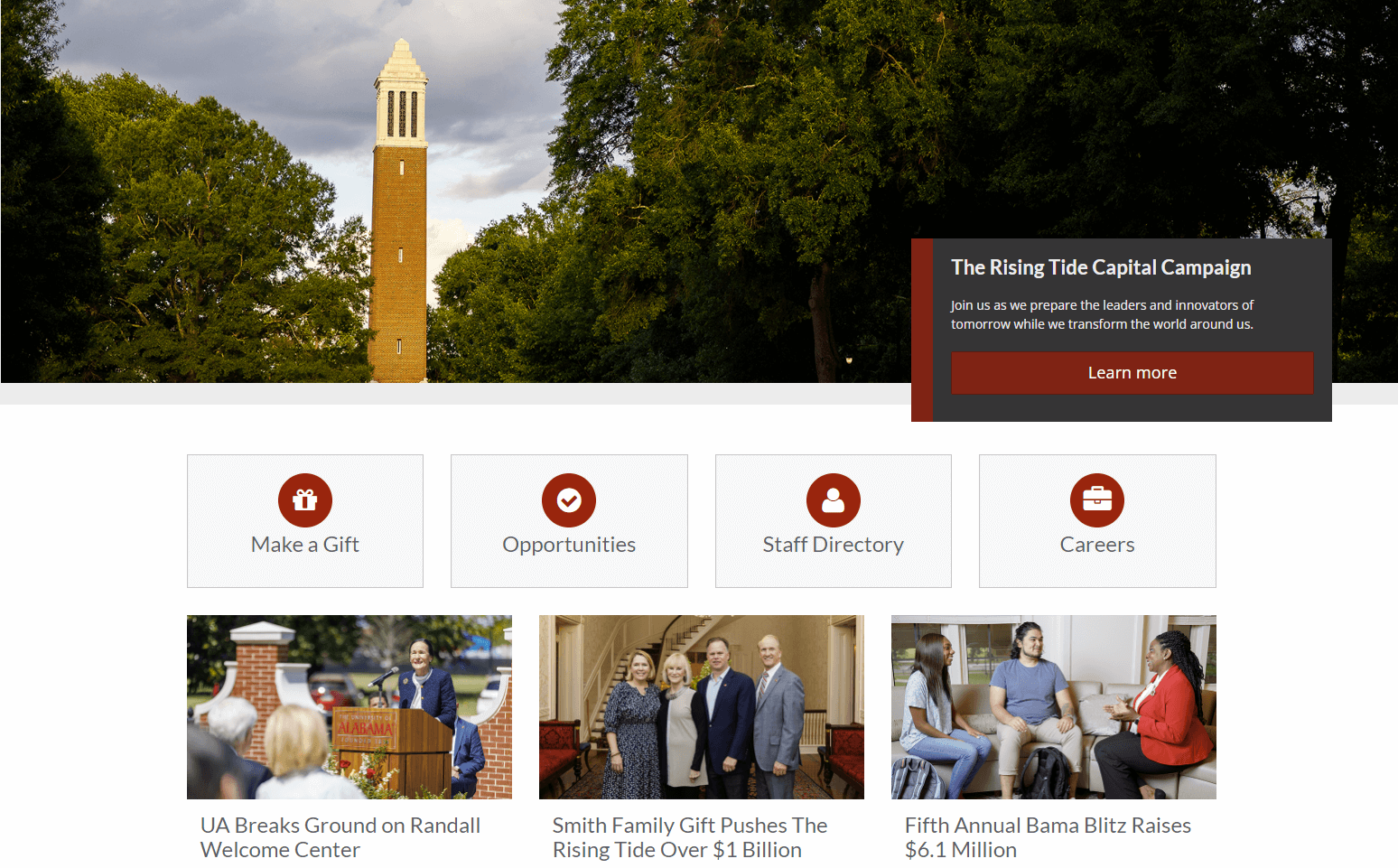
- Website. Your university’s website will be your online hub for donor engagement. Create specific web pages to let visitors learn more about your fundraising campaigns, including their purpose and goals, and highlight different campaigns donors can participate in, such as scholarships or your capital campaign. For example, take a look at how The University of Alabama has organized its giving page with options for visitors to make a gift or view additional fundraising opportunities.
5. Show the impact of donations.
Don’t underestimate the power of a well-developed case for support. Your case for support is the compelling story you use to grab audience members’ attention and show them that giving to your institution is worth their time and money.
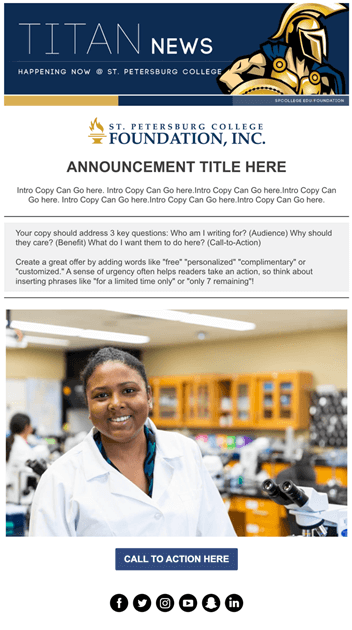
For example, St. Petersburg College in Florida turned to BWF Zuri for support with an ambitious $30 million to $40 million campaign. BWF Zuri worked with the university to develop a case for support centered around four core messages, along with content development, graphic design, and digital marketing materials. These services allowed the college to create a focused, consistent plan and message.
Here’s an example of an email template created for the campaign:
Share photos, data, and impact stories that demonstrate prospective donors’ potential impact on your university’s mission. Use donor-centric language to highlight the essential role potential donors play in supporting your institution’s success.
For instance, instead of saying, “Our university offered 100 additional scholarships this year to incoming first-year students,” say, “Because of donors’ generous support, 100 additional scholarships were awarded to incoming first-year students.”
For another real-world example, check out this video for Arizona State University’s 2022 giving day. It focuses on a single student’s story and directly connects the opportunities available to students to donors’ gifts.
Whether you’re creating a video, photo essay, or multimedia blog post, make sure your donor outreach is authentic. Ensuring your stories and imagery are genuine is more important than having a professional, sleek look for your marketing materials.
6. Offer flexible giving options.
Donors will appreciate having options for how they want to show their support for your fundraising campaigns. Offer multiple flexible giving options, such as:
- Online donations. Ensure your online donation page can accept a variety of payment methods, including credit/debit cards, PayPal, Stripe, and more.
- Mail-in donations. Send pre-addressed return envelopes to supporters so they can send cash or check donations.
- Planned gifts. A planned gift is a donation that a supporter promises to give now but fulfills later. Planned gifts are also known as legacy gifts.
- In-kind donations. In-kind gifts are non-financial donations, such as gifts of supplies or equipment. For example, some of your audience members may work for tech companies that can donate equipment such as laptops to students.
Highlight these options on your website’s giving page, across your social media pages, and in your email newsletters. Doing so will make donating more convenient for prospects, increasing the likelihood that they’ll follow through.

7. Make your university giving day spectacular.
A giving day is a fundraising campaign with clearly defined time constraints (usually 24 hours) during which supporters can submit their gifts. The world’s most well-known giving day is Giving Tuesday, which takes place on the Tuesday after Thanksgiving each year.
Your university might participate in Giving Tuesday as well as a separate giving day on any day you choose during the year. No matter which giving day you’re preparing for, keep these tips in mind:
- Set a goal. Make sure your goal is ambitious but realistic. Review results from previous years to set a goal that’s achievable yet higher than campaign totals.
- Create a theme and a unifying message for each year. Create a slogan or theme to inspire supporters. For example, the University of Arkansas’ inaugural 2025 giving day had the tagline “ONE DAY, ONE U of A,” to emphasize the 24-hour time limit of their giving campaign.
- Start planning well in advance. For Giving Tuesday, it’s helpful to start planning a few months in advance, toward the end of the summer. This gives you enough time to create your case for support and develop marketing materials.
- Show fundraising progress. Display a fundraising thermometer or other visual representation on your website to demonstrate fundraising progress.
- Plan a giving day event. Celebrate your giving day with an on-campus event. Make your event a can’t-miss affair with live music, famous alumni, and complimentary food and merchandise.
- Call prospective donors to ask for their support directly. Identify likely prospective donors within your database to reach out to directly. Thank them for their past contributions and communicate your case for support to show the impact their gifts can have on this year’s campaign.
Your giving days can bring in a significant amount of funding in a short amount of time. When you plan them carefully and seek out multiple ways to engage your audience, you can exceed your fundraising goals year after year.
8. Create a donor appreciation plan.
Saying “thank you” is a simple yet powerful way to show donors how much your university values them. Plus, you can encourage donors to give again in the future when they see that their past contributions were recognized and appreciated.
Here are a few ways you can show gratitude to your donors:
- Personalized gratitude videos. A personalized thank-you video can capture donors’ attention and show them that your organization values their involvement. Recruit student ambassadors to create meaningful thank-you videos for donors.
- Donor appreciation walls. A donor appreciation or recognition wall is a virtual or physical installation that lists the names of top donors to a certain campaign. Donor recognition walls give donors a sense of pride in their gifts and encourage others to get involved in your next campaign to receive similar public recognition.
- Handwritten thank-you letters. A handwritten thank-you note provides an extra-special touch to your donor appreciation efforts. If your office works with student employees, you can recruit them to help write thank-you letters, which will make them more authentic. To save time, focus your letter writing on major or long-time donors.
Throughout your donor appreciation efforts, show supporters the impact of their donations on your university. For example, send email updates to donors letting them know you completed construction of your new library wing with their help. Or, share videos and photos of scholarship recipients who were supported by donors’ contributions.
When donors see the powerful impact of their gifts, they’ll be more inclined to give again.
9. Work with a strategic fundraising partner.
Managing university fundraising campaigns can be complex, especially when your school is launching multi-million dollar efforts. When you team up with a fundraising consultant, you can benefit from the consultant’s expertise and gain access to extra support for your campaign.
For instance, fundraising specialists such as the BWF Zuri team help build effective giving campaigns and donor engagement programs. These professionals take a data-driven approach to help boost your ROI.
BWF Zuri’s services include:
- Campaign planning and management
- Annual giving and digital marketing
- Prospect development and research
- Systems selection and implementation
- AI and data science
- Strategic communications and branding
These services can transform a university’s fundraising efforts by bringing a professional, third-party perspective and practical strategies rooted in real-world experience. To learn more about how BWF Zuri can support your higher education fundraising efforts, reach out today to start the conversation.
University Fundraising: FAQs
What are the best strategies for university fundraising?
Successful university fundraising requires a mix of targeted prospect research, multichannel marketing, and personalized donor engagement. Instead of just focusing on alumni, institutions should cultivate relationships with parents, faculty, and corporate partners. Using data-driven tools like predictive analytics and CRM software helps fundraisers segment audiences and tailor their appeals for maximum impact.
How do universities raise money?
Universities raise money through a combination of annual giving campaigns, capital campaigns, planned giving, and major gift outreach. They leverage specific events like Giving Days, alumni reunions, and crowdfunding initiatives. Additionally, universities accept various donation types, including cash, stock transfers, donor-advised funds (DAFs), and in-kind gifts to support scholarships, faculty research, and campus facilities.
How can higher education institutions increase alumni giving?
To boost alumni giving, universities must move beyond transactional requests and focus on value-driven engagement. This is especially true for young alumni, who respond better to networking events, professional development opportunities, and personalized outreach. Show authentic appreciation and clearly demonstrate the real-world impact of their donations to encourage long-term, sustainable support from graduates.
How is AI being used in university fundraising?
Artificial intelligence is transforming higher education fundraising by automating repetitive tasks and providing deep data insights. Universities use AI tools for predictive modeling to identify high-capacity prospects, personalize marketing content, and recommend the best next actions, such as optimal ask amounts and outreach timing. This allows gift officers to focus on in-person relationship building.
What is the purpose of a university giving day?
A university giving day is a time-bound, typically 24-hour fundraising campaign designed to create urgency and community excitement. By using a unifying theme, matching gift challenges, and live progress trackers, giving days engage a broad audience of students, alumni, and parents. They are highly effective for acquiring new donors and boosting overall participation rates.
Wrapping Up: Launch Your Improved University Fundraising Strategy Today
With any fundraising campaign, your primary goal should be to foster stronger camaraderie among the students, alumni, faculty, staff, and parents who make up your university’s community. Using these tips, you can take your university fundraising campaigns to the next level and engage your audience members more effectively.
Looking for more information on planning successful higher education fundraising campaigns? Review these additional resources:
- The Annual Giving Roadmap: How to Raise More Yearly Gifts. Your annual giving campaign is likely your university’s most important yearly fundraising effort. Follow these eight steps to craft a sustainable annual giving strategy.
- Digital Fundraising: 10+ Revolutionary Campaign Ideas. Looking for some effective online fundraising ideas to complement your university’s campaigns? Start with this guide to digital fundraising.
- 3 Keys to Grabbing — And Keeping — Your Audience’s Attention. Capturing supporters’ attention is key to driving donations. Use these three strategies to spark and keep your audience’s attention.
Let’s Talk
Find out how BWF Zuri can partner with you to launch your university fundraising strategy.