
Gratitude is powerful. But it is not a fundraising strategy.
A lifesaving intervention, a compassionate clinician, an unexpected recovery, or the feeling of being seen, known, heard, and supported during one of life’s most vulnerable moments can leave a lasting impression on patients and families. Yet even an extraordinary care experience does not necessarily mean a grateful patient will be moved, or know how, to become a grateful patient donor.
This is the gratitude gap: the space between appreciating exceptional care and turning that gratitude into generosity.
Closing the gap requires more than “just” identifying grateful patients with financial capacity. Healthcare organizations must create thoughtful, intentional pathways that help people connect their experiences to what their generosity could make possible for others—and we need to make it easy for them to act.
Gratitude Opens the Door, but What Inspires Giving?
To better understand which pathways resonate with potential donors, BWF, now BWF Zuri, has spent more than 25 years studying how affluent Americans make charitable decisions related to hospitals and healthcare organizations. Conducted every two years, the survey asks donors directly about their motivations, priorities, communication preferences, and experiences. The 2025 BWF Healthcare Survey: What the Affluent Think About Healthcare included respondents with household incomes of at least $250,000 who had supported a healthcare organization within the previous 12 months.
The findings offer an important donor perspective on the gratitude gap. Personal experience matters, but so does understanding why support is needed. Forty-eight percent of respondents said a family or personal experience could motivate future giving. Nearly the same proportion, 46%, said they would be motivated to give if they better understood why their support was needed. A patient may leave feeling deeply grateful and still not know what a gift could accomplish, where support is most needed, or how to take the next step.
Only two percentage points separate the motivations described above. The emotional connection created through care may open the door to philanthropy, but meaningful, authentic engagement with a fundraising professional and a compelling case for impact help people understand why they should walk through it.
Moving from gratitude to generosity is not the result of a single message, invitation, or interaction. It begins with a hospital or healthcare organization showing why its mission and work to care for the community, not simply the patient’s positive experience, merit philanthropic support. It continues by creating appropriate opportunities to engage without assuming that every patient is able or ready to give. And, finally, when someone does make a gift, the organization must demonstrate its impact to deepen, maintain, and grow the relationship.
Connecting Gratitude to a Larger Purpose
The survey reveals another important signal. While 68% of respondents supported healthcare causes during the previous year, only 35% supported hospitals. When asked to rank their philanthropic priorities, respondents favored healthcare causes over hospitals by nearly four to one.
Where donors give is shaped by many factors, including personal experience, affinity for an issue, trust in an organization, a meaningful invitation, and confidence that a gift will make a difference. The desired scale of impact matters, too. Some donors want to improve care in their own communities, while others are motivated by the potential to advance research, treatment, or access on a national or global scale. Organizations gain an advantage when they connect these motivations to a clear, accessible case for support.
Disease-focused organizations often do this well by defining an urgent challenge, giving supporters a visible role, and connecting generosity to passions and impact, but from a broader perspective. Light the Night, created by The Leukemia & Lymphoma Society, now Blood Cancer United, invites communities to “bring light to the darkness of cancer.” Its illuminated lanterns allow survivors, families, and supporters to honor loved ones, stand together, and advance research, patient support, and advocacy. By connecting personal experience to collective action and tangible purpose, Light the Night has raised more than $1.12B since its inception.
Hospitals and health systems can apply the same principle without narrowing their missions. Riley Children’s Foundation’s Every Child Deserves Riley campaign presents Riley Children’s Hospital as the means to a statewide goal: ensuring that every Indiana child can access world-class pediatric care, specialists, research, and family support.
Both examples answer the question donors are asking: What change will my gift help make possible? Hospitals that rely on institutional loyalty or lead with broad priorities, construction projects, or equipment risk making that answer harder to discern.
Lead with Impact, Not Institutional Needs
The survey data reinforces this distinction. The opportunity to positively impact the cure of a disease or the treatment of an illness by supporting medical research motivated 58% of respondents under age 45 and 64% of those age 45 and older. Capital improvement projects motivated only 23% and 14% of those groups, respectively. Donors are not rejecting hospitals or their capital needs. They are signaling that the “why,” meaning the human result their giving can help achieve, is most often more compelling than the project itself.
Grateful patient philanthropy carries two opposing risks:
- assuming patients do not want to give and never inviting them, or
- assuming that a positive care experience and financial capacity will naturally lead to a gift.
Effective programs distinguish between extending an invitation and presuming interest. Nearly one-quarter of respondents selected “If asked, I might give,” demonstrating the importance of creating opportunities to engage. At the same time, gratitude and capacity alone do not indicate that someone is ready for a fundraising conversation.
A disciplined approach balances these realities, using HIPAA-compliant data, clear criteria, clinical partnership, and human judgment to guide when and how outreach occurs.
The First Gift is Just the First Gift
A first gift may capture an emotional moment. A lasting relationship, along with future giving, depends on what happens next.
Only half of survey respondents felt very informed about the impact of their giving, while 11% did not feel informed at all. This matters when donor retention continues to decline across the nonprofit sector.
Better stewardship does not necessarily require more elaborate communication. It requires relevant communication delivered in a timely, effective way, and via preferred pathways. Fifty-four percent of survey respondents preferred to receive impact updates by email. The opportunity is to combine that efficiency with personalization by sharing the outcomes, stories, and progress most closely connected to each donor’s experiences and interests.
Six Questions for Closing the Gap
Strong grateful patient programs align strategy, data, communications, clinician engagement, fundraising, and stewardship around one purpose: creating a meaningful path from gratitude to impact.
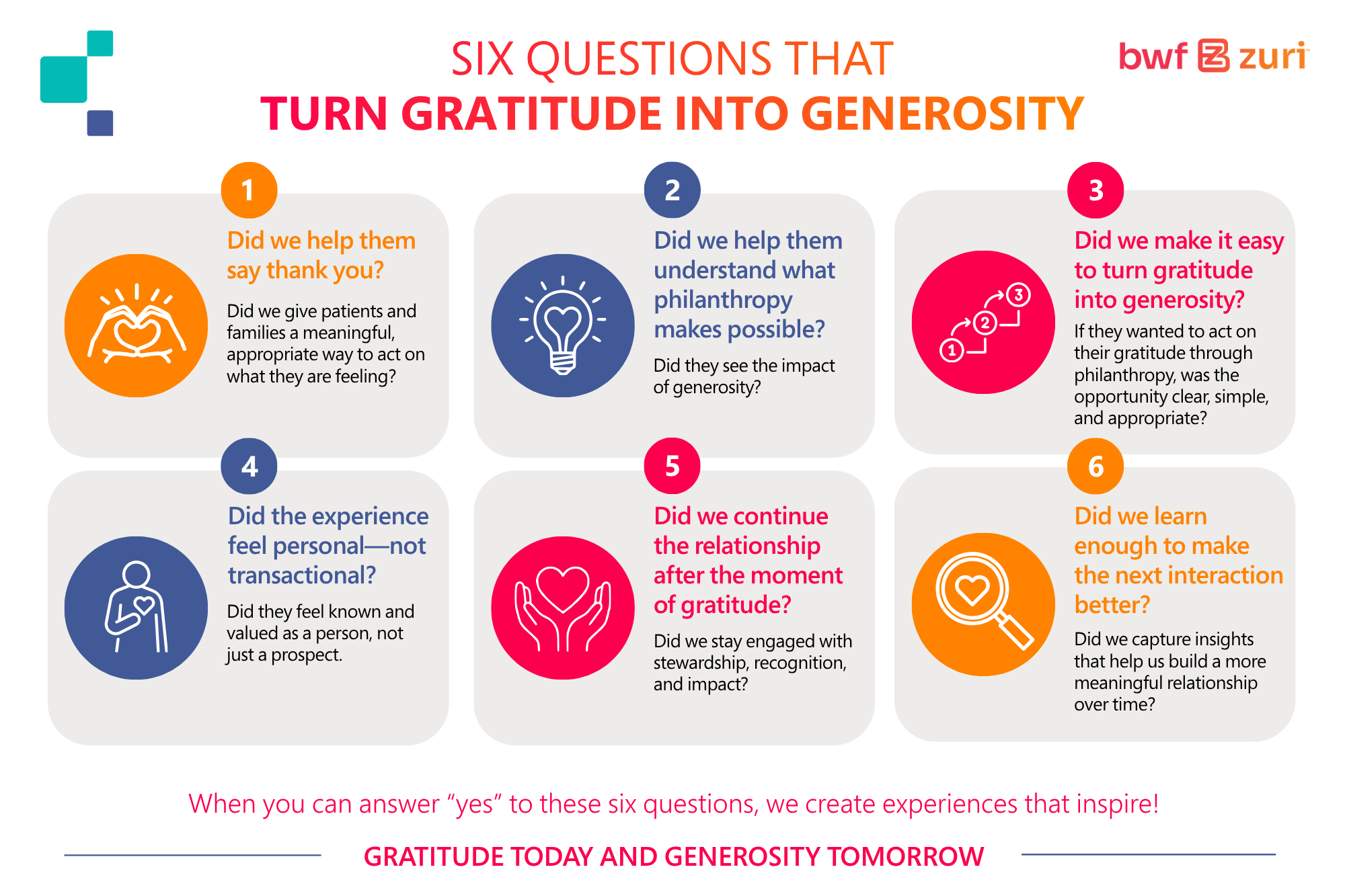
BWF Zuri’s six-question framework offers a practical test:
- Did we help patients and families say thank you?
- Did we help them truly understand what philanthropy makes possible and give then specific examples of that impact?
- Did we make it easy to turn gratitude into generosity?
- Did the experience feel personal rather than transactional?
- Did we continue the relationship in a meaningful, donor-centered manner after the moment of gratitude?
- Did we learn enough to make the next interaction even better and more personal?
Answering “yes” requires more than screening patients, training clinicians, or “launching a grateful patient program” in isolation. BWF Zuri helps healthcare organizations connect these elements by assessing and designing grateful patient fundraising strategies, strengthening data and analytics, engaging clinical partners, developing compelling funding priorities, and building personalized donor journeys.
Exceptional care may inspire gratitude. Healthcare organizations must turn it into generosity by giving that gratitude purpose, creating an appropriate donor-centered path for engagement, and showing patients and families how their experiences can help make healing possible for someone else.