
BWF Zuri recently completed an international fundraising program assessment and benchmarking project with several U.S.-based research institutions, resulting in valuable insights into international fundraising. This article explores the third success factor: robust research and its role in identifying international fundraising opportunities, navigating regulations and evaluating market potential.
Success Factor Three: Robust Research
As discussed in our previous articles, BWF Zuri completed an international fundraising program assessment and benchmarking study with several U.S.-based institutions that maintain a fundraising presence outside of the United States. The first factor we discussed as critical to successfully raising money abroad was structural consistency; the second factor was appropriate funding. The third factor, robust research, helps institutions understand the opportunities, risks and regulatory considerations that shape international fundraising strategies..
Most of us know what research means in the context of sponsored research or prospect research on key constituents. In the context of international fundraising, robust research can mean a variety of things. When assessing how much effort an institution plans to put into cultivating constituents abroad, it is important to know the local regulations surrounding fundraising. Are there donor privacy or due diligence laws or processes in place that your organization must adhere to? Are there financial implications for entities outside of the country to raising money within it, or tax considerations for donors who want to make a gift outside of their home country? Finally, when we take these considerations into account along with the overall culture of philanthropy and the population of constituents we have within that country, is dedicating staff time to cultivating constituents in this region a worthwhile investment?
Due Diligence and Donor Privacy
Due diligence matters in any fundraising program, but it gets more complicated across borders. Alongside a prospect’s philanthropic interest and financial capacity, you must weigh Institutions must consider reputational risk, the source of donors wealth, and any legal or political issues that could affect whether a gift can be accepted.
In BWF Zuri’s international fundraising benchmarking study, participants took a range of approaches. Some ran international prospects through the same review process used for domestic donors, while others added screening or approvals. Several also brought in internal partners, such as gift acceptance committees or risk management teams, to review proposed international gifts. These findings reinforce the importance of establishing clear due diligence policies, including criteria for when a gift requires additional review.
For a closer look at how organizations approach these decisions, BWF Zuri’s 2024 International Due Diligence Survey offers insights into due diligence practices, risk priorities, and thresholds for additional review.
Donor privacy regulations add another layer of consideration. The European Union’s General Data Protection Regulation (GDPR) sets rules for how organizations collect, process, and retain personal information, including data used in prospect research and outreach. For U.S.-based organizations, that can change how prospect information is gathered, stored, and shared between teams. Other countries have similar requirements, so it’s important to understand the local rules before expanding international fundraising efforts.
Research practices that are routine in the U.S. may not be permitted elsewhere. Legal counsel and your prospect development teams can help establish compliant research practices while supporting meaningful relationships with international constituents
Financial Regulations
Philanthropy is global, but the rules around it are not. Laws on charitable solicitation, tax incentives, and cross-border giving vary widely from country to country, and it’s worth understanding them before developing an international fundraising strategy
For example, the United Kingdom offers tax benefits for qualifying charitable donations through its Gift Aid program, but gifts made directly to U.S.-based institutions generally do not qualify. Institutions may instead establish U.K. charities or work with eligible charitable intermediaries to facilitate tax-efficient giving. In mainland China, regulations governing overseas nonprofits impose additional requirements on institutions seeking to operate locally. These differences underscore the importance of understanding local regulations when planning international fundraising.
One useful resource for comparing these environments is the Global Philanthropy Environment Index (GPEI) from the Indiana University Lilly Family School of Philanthropy. The index scores economies on six factors: the ease of operating a philanthropic organization, tax incentives, cross-border philanthropic flows, and the political, economic, and sociocultural environments. It’s a good starting point for understanding where conditions favor philanthropy and where barriers may exist. A country with significant wealth and a large alumni base may look promising on paper, yet restrictive giving regulations or limited tax incentives can limit it’s fundraising potential.
Practical Example: Evaluating Country-Level Fundraising Potential
Understanding the regulatory environment is only half the picture. Institutions must also evaluate at the size and strength of their existing constituent base, its philanthropic capacity, its giving history, and what it would take to cultivate donors in each market.
As discussed in the previous article on appropriate funding, a Global Constituency Analysis can help institutions prioritize markets based on donor engagement, capacity and the ease of international giving.
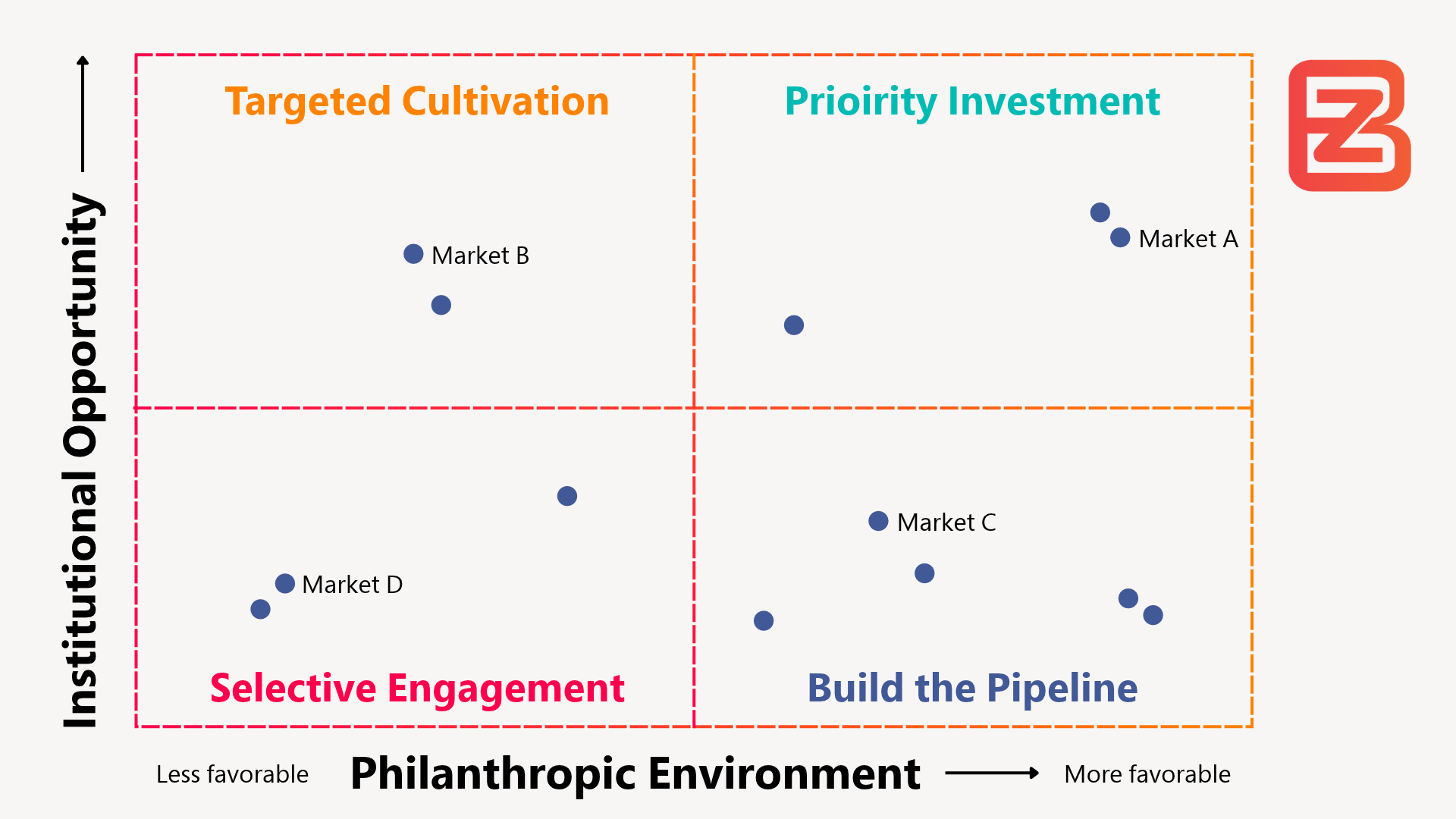
This is where a more comprehensive country-level assessment that weighs the philanthropic environment against the organization’s own donor potential pays off. For example, one country might hold a large concentration of high-capacity alumni but have a difficult environment for cross-border giving. Another might have fewer constituents but stronger alumni relationships and a more favorable philanthropic climate. Both present opportunities, but each calls for a different approach and level of investment.
The illustrative example below shows how comparing institutional opportunity with the philanthropic environment can help distinguish markets worth sustained investment from those better suited to targeted engagement.
Conceptual illustration only. No real GPEI scores, constituent records, weighting formulas, or client results are used.
International Fundraising Market Assessment
Conclusion
Successful international fundraising takes more than knowing where alumni and high-capacity prospects live. Institutions must also understand the conditions that shape their ability to cultivate donors and secure gifts in each market. By combining prospect research with an understanding of local regulations and philanthropic culture, institutions can make more informed decisions about where to invest resources and which markets offer the greatest long-term potential.
Robust research also provides a foundation for the next critical success factor: long-term cultivation. In the next article in this series, we’ll explore what it takes to build and sustain meaningful relationships with international donors.
To learn more about strengthening your international fundraising strategy, contact BWF Zuri.